


Table of Contents
Choosing an affiliate program plugin can feel like a small technical decision at first. You compare a few options, check the features, install one, and move on.
The real test comes later, when your program starts growing. Maybe your commission rules are too rigid. Maybe affiliates stop checking their dashboard because there’s nothing useful there. Maybe payouts become harder to verify, or you can’t clearly see which partners are actually driving sales.
That’s when the plugin stops feeling like a simple setup choice and starts affecting how much control you have over your entire affiliate program.
The right affiliate management plugin should help you track referrals, manage commissions, support affiliates, handle payouts, and understand what’s working without forcing you into messy workarounds.
In this post, we’ll walk through 8 features to look for before you choose a plugin, or before you decide whether your current one is still doing the job.
1. Ecommerce Integration That Actually Connects to How You Sell
Every other feature on this list is irrelevant if your plugin doesn’t integrate cleanly with your store.
“Integration” gets used loosely, so let’s be specific: clean integration means your plugin automatically tracks a purchase back to the affiliate who drove it – no manual reconciliation, no delayed syncing, no missed commissions because a sale happened through a checkout flow the plugin didn’t recognize.
For WordPress businesses, that means native support for WooCommerce, MemberPress, and Easy Digital Downloads (EDD). These three cover the majority of how digital products and memberships are sold on WordPress, and a plugin that handles all three gives you room to sell in different formats without rebuilding your affiliate setup every time.
Easy Affiliate integrates directly with WooCommerce, MemberPress, and EDD. When a purchase goes through any of these, the commission attribution happens automatically – no workarounds, no third-party connectors needed.
If a plugin you’re evaluating requires custom configuration to work with your specific checkout flow, that’s a red flag. You’ll be maintaining that configuration every time either platform updates.
2. An Affiliate Dashboard That Keeps Your Affiliates Engaged
Your affiliates are a volunteer salesforce. They don’t have to promote you – they choose to, and they’ll keep choosing to as long as it’s worth their time and effort.
A weak dashboard is one of the fastest ways to lose that engagement. If an affiliate logs in and can’t immediately see their active links, their click and conversion stats, and what they’ve earned and what’s pending – they disengage. Not dramatically. They just eventually stop.
A good affiliate dashboard gives affiliates everything they need without requiring them to ask you for it: their unique referral links, real-time performance stats, payout history, and any creatives or banners you’ve made available.
It should also be customizable – your program is different from someone else’s, and you should be able to add navigation links and a welcome message that reflects how your program actually works.
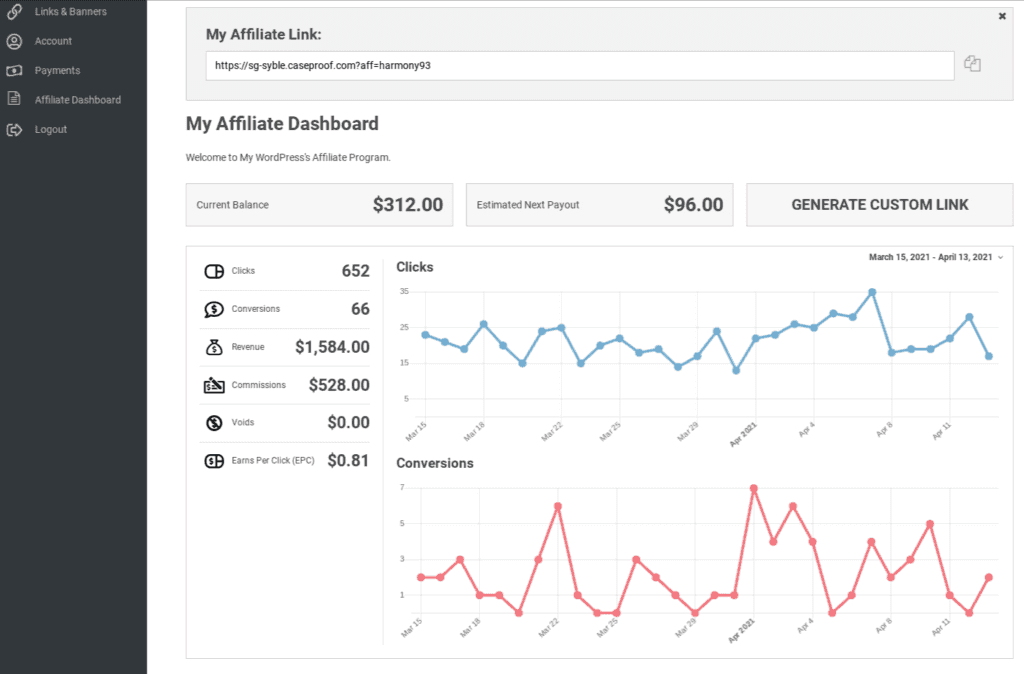
Easy Affiliate’s dashboard is built with this in mind. You can tailor it to your program, and your affiliates get a clean, organized view of everything relevant to them. The less they have to contact you for basic information, the more time they spend promoting.
3. Commission Management With Real Flexibility
Not every affiliate is equal, and your commission structure should reflect that.
The bare minimum – a flat percentage for everyone – works when you’re starting out. But as your program grows, you’ll want to offer different rates for different affiliates, fixed-amount commissions for specific products, and recurring commissions for subscription-based products where the affiliate should earn on the lifetime of the customer, not just the first sale.
A plugin that only supports one commission type forces you to treat all affiliates the same, which means you can’t reward your top performers differently, can’t run product-specific promotions, and can’t structure a recurring model that reflects how your revenue actually works.
Easy Affiliate supports percentage-based commissions, fixed commissions, and per-affiliate custom rates – so you can negotiate a different deal with a high-volume affiliate without changing what everyone else earns. For subscription products built on MemberPress, it handles recurring commissions automatically.
Commission flexibility isn’t a nice-to-have. It’s the main lever you have for attracting quality affiliates and keeping them active.
4. Advanced Commission Rules for Programs That Want to Scale
Once your program has traction, flat rates stop being enough.
Performance tiers – where affiliates unlock a higher commission rate once they hit a certain number of conversions in a period – are one of the most effective ways to incentivize your best affiliates to push harder. They work because they reward the behavior you actually want: consistent, high-volume promotion.
Most basic plugins don’t support this. They let you set a rate and leave it there. Advanced commission rules let you define the conditions under which rates change automatically – no manual adjustments, no tracking spreadsheets, no emailing affiliates to tell them they’ve hit a new tier.
Easy Affiliate’s advanced commission rules let you build performance-based structures that scale with your program. If you’re not at the point where tiers feel necessary yet, you will be – and it’s worth having a plugin that won’t require you to migrate when you get there.
5. Payouts That Don’t Create Friction
Affiliates who get paid on time stay active. Affiliates who have to chase their commissions, wait through manual processing, or deal with clunky payment flows may stop promoting.
One-click PayPal payouts sound like a small thing. It isn’t. Reducing the work it takes to get money out of your program directly affects how reliable your affiliates perceive you to be – and reliability is what keeps a voluntary salesforce motivated.
Easy Affiliate makes payouts simple. With one-click PayPal payments, you can pay all your affiliates in a single action. No exporting CSVs, no logging into a separate platform, no per-affiliate manual transfers. Affiliates see their payment status update immediately, which builds the kind of trust that keeps them active long-term.
Beyond PayPal, look for a plugin that supports multiple payout options. Not all affiliates use PayPal, and giving them alternatives removes another potential point of friction between your program and their earnings.
6. Fraud Protection – Specifically PPC Fraud Protection
When your program is small, fraud is a theoretical problem. Once it has any real volume, it becomes a real one – and it tends to be invisible until you go looking for it.
The most common and costly form is PPC fraud: affiliates generating fake clicks through paid ads that trigger commissions without ever producing a real customer. It inflates your payout numbers, erodes your margins, and is easy to miss if your plugin isn’t actively watching for it.
Easy Affiliate includes built-in fraud protection with specific safeguards against PPC fraud. It monitors for suspicious click patterns – repeated clicks from the same IP, clicks that don’t produce conversions at any reasonable rate, unusual traffic spikes from individual affiliates – and flags or blocks them before they turn into payouts.
The affiliates you want in your program don’t need you to be lenient about fraud. Being rigorous here protects your legitimate affiliates just as much as it protects your margins. It also signals to serious affiliates that you run a program worth being part of.
7. An Application and Approval Workflow That Lets You Control Who Gets In
Most people think of affiliate recruitment as a numbers game – the more affiliates you have, the better. That’s not quite right.
The wrong affiliates create problems that compound over time: low-quality traffic that doesn’t convert, brand association you didn’t choose, and fraud exposure that increases with every unvetted account you approve. Controlling who gets into your program matters more than growing your affiliate count quickly.
A proper application and approval workflow means affiliates have to apply to join, you review those applications, and you approve or deny them before they get access to links and tracking. It’s a simple gate, but most basic plugins skip it – defaulting to open enrollment or auto-approval because it’s easier to set up.
Easy Affiliate gives you a full application flow: customizable application forms, a review queue, and manual approval controls. You decide who represents your brand. As your program grows, you can also use this data to identify what your best affiliates look like and screen more effectively for it.
8. A Links and Banners Tool That Does the Work for Your Affiliates
Affiliates promote more when you make it easy to promote. A links and banners tool is how you do that.
This feature lets you create affiliate-specific tracking links and banner ads from within your plugin – already tagged to the right affiliate, already formatted for use. Your affiliates log into their dashboard, grab the link or banner they need, and drop it wherever they’re promoting. They don’t have to build links manually or ask you to send them updated creative.
The sharing mechanism matters here. Banners and links that live in the affiliate dashboard get used. Banners and links that get emailed out once and never updated don’t.
Easy Affiliate’s dashboard makes your creative assets available to affiliates at all times, so there’s no version-control problem and no barrier between an affiliate having an idea and acting on it.
It’s one of the more operational features on this list, but don’t underestimate how much it affects actual promotion activity.
Frequently Asked Questions
What features should an affiliate management plugin have?
At minimum: ecommerce integration with your checkout platform, an affiliate dashboard, flexible commission management, a payout system, fraud protection, and a links and banners tool. For programs that want to scale, add advanced commission rules and an application and approval workflow.
What is affiliate fraud protection?
Affiliate fraud protection is a feature that monitors your program for suspicious activity – repeated clicks from the same IP address, unusually high click-to-no-conversion ratios, or traffic patterns that suggest artificial generation. PPC fraud specifically refers to affiliates using paid ads to generate clicks that trigger commission payouts without producing real customers.
What are affiliate commission tiers?
Commission tiers are performance-based rules that automatically increase an affiliate’s commission rate once they hit a defined threshold – for example, earning 20% on their first 10 sales and 25% on every sale after that. They incentivize high-volume affiliates to keep pushing without requiring manual adjustments on your end.
What does one-click payout mean in affiliate marketing?
One-click payout refers to a plugin feature that lets you pay all your affiliates in a single action through an integrated payment provider like PayPal – rather than processing each payment manually. It reduces the admin work involved in running payouts and makes the payment experience more reliable for affiliates.
Choose the Plugin Your Program Can Grow With
An affiliate program plugin isn’t something you want to keep replacing every time your program becomes more complex. The tool you choose now should be able to handle your commission structure, affiliate experience, tracking, reporting, payouts, and integrations as your program grows.
That’s why these eight features matter. They help you look past the basic setup screen and ask the bigger question: can this plugin actually support the kind of affiliate program you’re trying to build?
If you’re choosing a plugin for your WordPress site, or reviewing the one you already use, run it through this list before you commit.
Easy Affiliate has all eight features covered, giving you the tools to recruit affiliates, track every referral, manage commissions, monitor performance, and pay partners without piecing your program together across separate systems.
Are you running an affiliate program on WordPress? Which of these features is your current plugin missing, or what’s one thing you wish it handled better? Let us know in the comments below.
If you liked this post, be sure to follow us on Twitter, Facebook, and LinkedIn! And don’t forget to subscribe in the box below.


Leave a Reply