


Table of Contents
You’ve decided to launch an affiliate program. Or maybe you’ve already launched one, and now the questions are piling up faster than the sign-ups.
What should your commission rate be? How does tracking actually work? What do you do when something looks like fraud?
An affiliate program is a partnership where you pay other people – your affiliates – a commission for every sale they refer to your business.
The mechanics are straightforward. The details are where most program owners get stuck.
This guide answers the most common affiliate program questions – organized by topic so you can jump straight to what you need.
Section 1: Getting Started
1. What exactly is an affiliate program, and how does it work?
An affiliate program is a performance-based marketing arrangement where your business pays a commission to partners who send you paying customers.
Each affiliate gets a unique tracking link. When someone clicks that link and completes a purchase, the sale is credited to that affiliate, and they earn the commission you’ve set.
The basic flow looks like this: you recruit affiliates, give them links, they promote your product to their audience, a visitor clicks through and buys, and your program records the sale and queues up a commission payout.
No sale, no payment. You only pay for results.
2. Is my business the right fit for an affiliate program?
Most businesses with a digital product, a recurring subscription, or a defined margin can run a productive affiliate program. The key question isn’t whether you can run one – it’s whether your margins leave room for a commission after you pay for traffic.
Affiliate programs work especially well when:
- Your product sells at a clear price point. Affiliates need to calculate what they’ll earn before they’ll promote.
- You have a customer lifetime value that justifies the acquisition cost. A 20% commission on a $50 product is $10. On a $500 product, it’s $100. The economics are very different.
- You can support partners with materials. Affiliates promote what’s easy to promote. If you can give them a banner, a landing page, and a clear value prop, you’re already ahead of most programs.
If your margins are very thin or your sales cycle involves a lot of manual back-and-forth, you may want to sort that out before recruiting affiliates.

3. Do I need an affiliate network, or can I run my own program?
Affiliate networks like ShareASale or CJ Affiliate give you access to their existing affiliate base, but they also charge platform fees, take a percentage of commissions, and put a layer between you and your partners.
Running your own program – directly on your website – means you keep more margin, own the relationship with your affiliates, and have full control over your terms.
The trade-off is that you have to recruit your own affiliates rather than pulling from a built-in marketplace.
For most small to mid-size WordPress businesses, a self-hosted program is the right starting point. You can always expand to a network later if you want broader reach.
| Easy Affiliate lets you run a fully self-hosted affiliate program directly from your WordPress site. No network fees, no third-party dashboards – your affiliates log in through your site, get their links, and see their stats in a branded portal you control. |
4. What do I need in place before I launch?
Launching before you’re ready usually means you’ll spend more time fixing things than growing. Before your program goes live, make sure you have:
- A defined commission structure. Know your rate, your cookie duration, and whether you’ll pay on first purchase only or recurring orders.
- An affiliate agreement. This sets the rules affiliates agree to before promoting your product. It protects you legally and sets expectations up front.
- A working checkout with tracking installed. Test a real transaction with a test affiliate link before you invite anyone.
- Basic promotional materials. At minimum: a banner, a product description, and a link. Affiliates are far more likely to start promoting when they don’t have to create everything from scratch.
- A payout plan. Know when you’ll pay, how, and what threshold you’ll set before commissions are released.
After launch, if you feel overwhelmed about Affiliate management, check out this 15-minute-a-day affiliate manager.
Section 2: Setting Up Your Commission Structure
5. What commission rate should I offer?
There’s no single right answer, but there is a framework. Start with your product’s profit margin and work backward. If your margin is 60%, a 20% commission still leaves you with 40% of the sale. If your margin is 15%, a 20% commission puts you in the red.
Industry benchmarks as of 2025:
- Physical products with tight margins: 5–15%
- Digital products and online courses: 20–50%
- SaaS and software subscriptions: 20–40%
Once you know what you can afford, look at what your competitors offer. You don’t need to be the highest-paying program in your niche, but if your rate is significantly lower than what affiliates can earn promoting a comparable product, recruiting will be an uphill battle.
6. What’s the difference between percentage-based and flat-rate commissions?
A percentage commission pays affiliates a set percentage of each sale. If the rate is 25% and someone buys a $200 product, the affiliate earns $50. This scales automatically with order value, which most affiliates prefer because higher-ticket buyers mean bigger earnings.
A flat-rate commission pays a fixed dollar amount per sale regardless of order value. This is simpler to communicate and works well when your product has a consistent price point. It also gives you more predictability in your cost per acquisition.
Neither is universally better. If your product has variable pricing or you want affiliates motivated to drive higher-value orders, percentage-based tends to perform better. If simplicity is a priority and your pricing doesn’t vary much, flat-rate keeps things clean.
7. Should I offer recurring commissions?
If your business model involves subscriptions or memberships, recurring commissions – where affiliates earn on every renewal, not just the first sale – are a significant advantage in recruiting. Affiliates evaluate a program based on what they can earn long-term, not just from the first transaction.
The catch is that recurring commissions compound over time. If you have a high-retention product and a large affiliate base, your commission costs grow as your subscriber base does. Model this out before you commit, especially if you’re offering a high percentage on recurring.
A common middle ground: offer a higher commission on the first sale and a lower rate on renewals. This still gives affiliates ongoing income without eating as deeply into your margin over the life of a customer.
8. What is a tiered commission structure, and do I need one?
A tiered commission structure rewards affiliates with higher rates as they hit performance milestones. A simple example: all affiliates start at 20%, move to 25% after $1,000 in referred sales, and hit 30% after $5,000.
Tiers work well once you have enough affiliates to segment by performance. They give your best partners a reason to keep promoting and create a visible incentive for newer affiliates to push harder.
If you’re just launching, keep it simple. A flat rate is easier to explain and easier to administer. You can always introduce tiers later once you understand what your top performers actually drive.
| Easy Affiliate’s Commission Level add-on lets you set percentage-based commission rates by affiliate level. You can start everyone at the same tier and promote affiliates as they hit your performance benchmarks – without managing it manually. |
9. How long should my cookie duration be?
Cookie duration is how long an affiliate gets credit for a visitor after that visitor clicks their link. If your cookie is set to 30 days and someone clicks an affiliate link today but buys three weeks later, that affiliate still earns the commission.
Thirty days is the industry standard and a reasonable starting point for most programs. For products with a longer purchase consideration window – software, high-ticket courses, B2B tools –60 to 90 days is common and makes your program more attractive to affiliates.
Amazon Associates famously uses a 24-hour window, which is why many affiliates deprioritize it in favor of programs that give them a fair attribution period. If a serious content creator is choosing between your program and a competitor’s, a 30-day versus 60-day cookie can be the deciding factor.
Section 3: Tracking, Technology, and How It All Works
10. How does affiliate tracking actually work?
When an affiliate shares their link and someone clicks it, a small file called a cookie is stored in the visitor’s browser. That cookie contains the affiliate’s unique ID. When the visitor completes a purchase, your affiliate software reads the cookie, identifies which affiliate referred them, and records the commission.
The process is automatic once your tracking is set up correctly. Your affiliate plugin handles the link generation, cookie setting, sale attribution, and commission recording – you don’t manually track anything. That said, tracking is only as reliable as your setup. A misconfigured checkout, a plugin conflict, or a site migration can break attribution silently, which is why testing before launch matters.
11. What happens if a customer uses multiple devices before buying?
Standard cookie-based tracking doesn’t follow users across devices. If someone clicks an affiliate link on their phone but completes the purchase on their laptop, most basic setups won’t connect those two sessions, and the affiliate may not get credited.
This is a known limitation of cookie-based attribution. Some programs address it through account-based tracking – where a logged-in user is tied to an affiliate referral regardless of device – but this requires more sophisticated setup. For most small programs, cookie-based tracking is sufficient, but it’s worth knowing the gap exists.
12. What is a referral cookie, and why does it matter?
A referral cookie is the tracking cookie placed on a visitor’s browser when they click an affiliate link. It stores the affiliate’s ID and has an expiration date that matches your cookie duration setting.
It matters because it determines who gets credit for a sale. If two affiliates send the same visitor to your site at different times, the last click typically wins under standard last-click attribution – meaning the most recent affiliate cookie overwrites the previous one. Some programs use first-click attribution instead, crediting whoever brought the visitor first. Both approaches are valid; just make sure your terms are clear about which model you use.
13. Do I need special software to run an affiliate program?
If you’re on WordPress, a dedicated affiliate plugin is the most practical option. It handles everything – affiliate registration, link generation, click tracking, commission calculation, payout management, and the affiliate-facing dashboard – without requiring custom development.
Running a program without dedicated software means tracking sales manually, generating links by hand, and managing payouts in a spreadsheet. That’s possible at very small scale, but it breaks down fast once you have more than a handful of affiliates.
| Easy Affiliate is a WordPress plugin built specifically for this. It integrates directly with WooCommerce, Easy Digital Downloads, MemberPress, and other popular platforms – so your affiliate program connects to your checkout without extra configuration. Affiliates get a branded dashboard on your site, and you get a centralized view of clicks, conversions, and commissions. |
Section 4: Recruiting and Managing Affiliates
14. Where do I find affiliates to recruit?
The best place to start is your existing audience. Customers who already bought from you and liked the experience are your most credible promoters. An email to your list explaining your program and what affiliates earn is often more productive than reaching out cold to strangers.
Beyond your own list:
- Your niche’s content creators. Search for bloggers, YouTubers, and podcast hosts who already talk about topics adjacent to your product. If they’re creating content your audience reads, they’re worth reaching out to.
- Social media communities. Facebook groups, Reddit communities, and LinkedIn groups in your niche often have active members who monetize their presence. Mention your program where it’s relevant and permitted.
- Competitor affiliate programs. If a competitor has a public affiliate program, the affiliates already promoting them are already warm to your product category. They’re a logical target.
- Your affiliate’s networks. Once you have a few active affiliates, ask them to refer others. A referral bonus for bringing in new affiliates who make sales is a cost-effective way to grow.
You should also check out these stellar tips for recruiting quality affiliates.
15. Should I approve affiliates manually or automatically?
Manual approval takes more time but gives you control over who represents your brand. You can review an applicant’s website, audience, and promotional approach before giving them a link.
Automatic approval is faster and removes friction for legitimate affiliates who would have been approved anyway. The downside is that it lets bad actors in without a check.
A practical middle ground: use auto-approval but set a short review window where you can flag and remove problematic applicants before they generate activity. Or require a short application form that auto-approves but filters by niche or URL, which weeds out most low-quality applications without requiring manual review of every one.
16. How do I onboard a new affiliate properly?
Most affiliates go inactive because they didn’t get a clear enough start. A good onboarding process removes the guesswork and gets them promoting faster.
The welcome sequence should include:
- Their affiliate link and instructions for how to use it
- Your commission rate, cookie duration, and payout schedule
- A short overview of your best-selling products and who they’re for
- A folder of ready-to-use creative assets – banners, product images, suggested copy
- What they’re not allowed to do (bidding on branded keywords, coupon spam, misleading claims)
The affiliate dashboard is also part of the onboarding experience. If your affiliates log in and see a clean, organized dashboard with their links, stats, and materials in one place, the program feels professional and worth their effort.
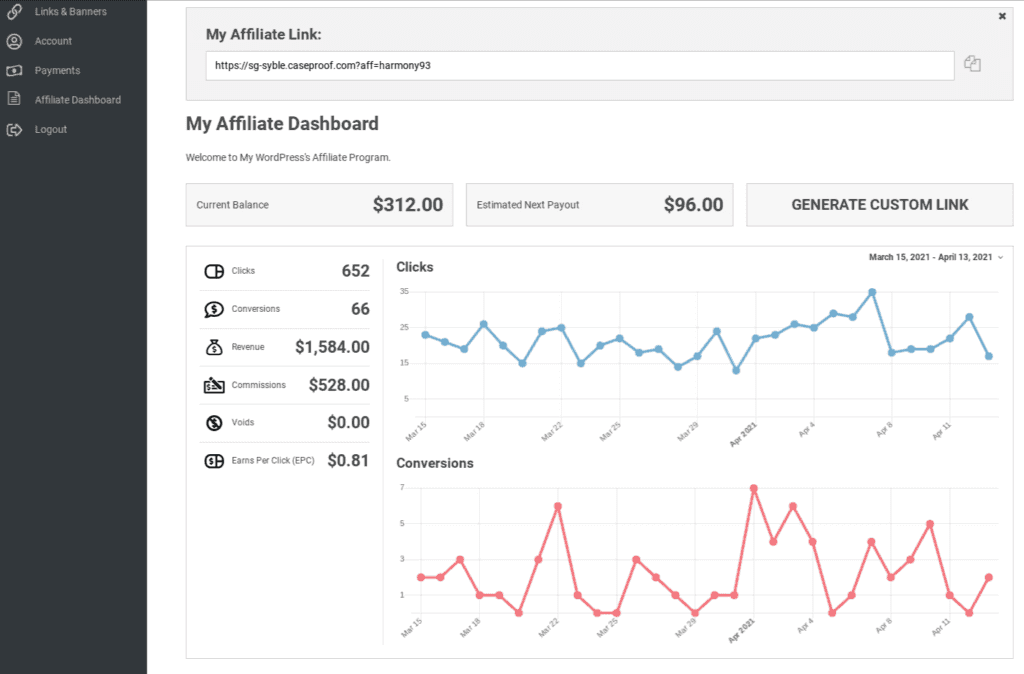
| Easy Affiliate includes a customizable affiliate dashboard where you can add a creatives hub – banners, link ads, and downloadable assets – so affiliates have what they need from day one. Automated welcome emails go out on signup, which means your first touchpoint with every new affiliate is handled without manual effort. |
17. How many affiliates do I actually need?
More affiliates do not mean more revenue. The 80/20 rule applies reliably in affiliate programs: roughly 80% of your revenue will come from 20% of your affiliates. Most programs have a core group of high performers and a large inactive tail.
A focused program with 20 active, well-matched affiliates will consistently outperform a bloated program with 500 members who mostly signed up and never promoted anything. Prioritize quality of fit over headcount, especially in the early stages.
18. What do I do about inactive affiliates?
Before you remove anyone, understand why they’re inactive. Most affiliates go quiet because they didn’t get enough support at the start, don’t have materials that make promoting easy, or haven’t been reminded the program exists.
A re-engagement email with a fresh asset, a limited-time commission boost, or a simple check-in often reactivates a portion of your dormant affiliates. For those who don’t respond after a couple of attempts, removing them from your active roster keeps your reporting clean and your list focused on people who are actually promoting.
Section 5: Paying Your Affiliates
19. When and how often should I pay affiliates?
Most programs pay monthly, which gives you enough time to verify sales, process any refunds, and batch payments efficiently. Some programs pay bi-monthly or on a rolling 30-day basis from the sale date.
Whatever schedule you set, communicate it clearly and stick to it. Late or inconsistent payments are one of the fastest ways to lose good affiliates. A reliable payout schedule signals that your program is professional and that you value your partners.
One important note: most programs hold commissions for a set period before releasing them – typically 30 to 60 days – to allow time for refunds to be processed. If a customer returns a product, you don’t want to be chasing a commission you’ve already paid out.
20. What payout threshold should I set?
A payout threshold is the minimum balance an affiliate needs to accumulate before a payment is triggered. Common thresholds range from $20 to $100.
The practical reason for a threshold is that small payments cost nearly as much to process as larger ones – PayPal and other platforms charge per transaction, so batching commissions until they reach a meaningful amount reduces your processing costs.
Set it low enough that new affiliates don’t feel like they’ll never see a payout, but high enough to be worth processing. $50 is a reasonable default for most programs. Make the threshold visible in your affiliate agreement and on your program page so there are no surprises.
21. What payment methods should I offer?
PayPal is the default for most affiliate programs because it’s widely used, relatively fast, and handles international payouts. For US-based affiliates, direct deposit via ACH or checks are also common.
If you have affiliates in multiple countries, payment friction is a real issue. Bank wire transfers work internationally but often carry fees on both ends. Services like Wise (formerly TransferWise) or Payoneer are increasingly popular for international affiliate payouts because the fees are lower than traditional bank transfers.
Offer what your affiliate base needs, not just what’s easiest for you. If your top affiliates are outside the US, a PayPal-only payout system is a friction point that could cost you those relationships.
| Easy Affiliate supports one-click PayPal mass payouts, which lets you pay all eligible affiliates in a single action from your WordPress dashboard. No exporting spreadsheets, no logging into PayPal separately – you review pending commissions and pay them out directly. |
22. How do I handle refunds and chargebacks?
Most programs reverse commissions when a sale is refunded. This is standard practice and should be clearly stated in your affiliate agreement. The mechanics depend on your software: most platforms automatically mark a commission as reversed when the associated order is refunded in your ecommerce system.
Chargebacks are trickier because they often come with a processing fee from your payment provider. Whether you also claw back the commission is a policy decision. Either approach is defensible – just document it clearly so affiliates aren’t blindsided.
If you’re seeing a high refund rate from a specific affiliate’s traffic, that’s worth investigating. It can be a sign of mismatched audience, misleading promotional content, or in some cases, manufactured conversions.
Section 6: Affiliate Fraud and Program Protection
23. What is affiliate fraud, and how common is it?
Affiliate fraud is when someone manipulates your tracking system to earn commissions they didn’t legitimately generate. It takes several forms:
- Cookie stuffing: Placing your affiliate tracking cookie on a visitor’s browser without an actual link click – often through hidden code – so the affiliate gets credited for purchases they had nothing to do with.
- Fake leads: Submitting fabricated contact information or completing transactions with invalid payment details to trigger commission payouts.
- Click fraud: Generating artificial clicks on affiliate links to inflate click counts or manipulate your program’s metrics.
- Self-referrals: Affiliates using their own link to purchase at a discount, effectively getting a commission on their own transaction.
It’s more common than most program owners assume. The good news is that the majority of fraud is detectable if you’re looking at the right signals.

24. How do I detect and prevent fraud in my program?
The clearest warning signs are affiliates with unusually high click-to-conversion ratios, traffic that comes from unusual geographic sources, or a pattern of purchases that are quickly followed by refunds.
Practical steps to protect your program:
- Use manual approval or a short review window before affiliates can generate commissions
- Set a minimum payout delay so commissions aren’t released until refund windows have closed
- Block self-referrals in your affiliate software settings
- Review your affiliate list periodically and investigate anyone with performance metrics that don’t make sense
- Require affiliates to agree to a clear terms document, so you have a basis for removing fraudulent accounts
| Easy Affiliate includes built-in fraud detection tools that flag suspicious activity automatically. You can also set commission locking periods so no payouts are released until you’ve had a chance to review new sales – a simple safeguard that stops fraud before it costs you money. |
25. What should be in my affiliate agreement?
Your affiliate agreement is a binding document that sets the terms of your program. Every affiliate should accept it before they can access their dashboard or links.
Key things to cover:
- Commission rates and payout schedule
- Cookie duration and attribution model
- What affiliates are and aren’t allowed to do (prohibited promotion methods, brand bidding rules, disclosure requirements)
- How and when commissions are reversed (refunds, chargebacks, fraud)
- Grounds for removal from the program
- FTC disclosure requirements – affiliates are legally required to disclose their relationship with you when promoting your products
Keep it clear and plain language. An agreement full of dense legal jargon doesn’t protect you any better than a clean, readable one – and it’s more likely to actually be read.
Section 7: Measuring Your Program’s Performance
26. What metrics should I track in my affiliate program?
The numbers that tell you the most about your program’s health:
- Clicks: How many people clicked affiliate links in a given period. Your baseline traffic metric.
- Conversions: How many of those clicks resulted in a sale.
- Conversion rate: Clicks divided by conversions. A very high rate can indicate fraud; a very low rate suggests affiliates are sending poorly targeted traffic or your landing page has a problem.
- Revenue generated: Total sales value attributed to affiliate traffic.
- Commissions paid: Your total affiliate cost for the period.
- EPC (Earnings Per Click): See Q28 below for why this one matters.
- Active affiliate count: How many affiliates generated at least one click in the last 30 days. This is more useful than your total affiliate count.
27. How do I know if my affiliate program is actually working?
The simplest measure is whether the revenue your affiliates generate exceeds what you’re paying them, including the time cost of managing the program. If affiliates are bringing in customers you wouldn’t have otherwise reached, and those customers are profitable, the program is working.
Beyond revenue, look at customer quality. Are affiliate-referred customers retaining at the same rate as your direct customers? Do they have similar order values? If affiliate traffic converts well but churns quickly, you may have a mismatch between what affiliates are promising and what your product delivers.
A realistic benchmark: most programs see activity concentrated in a small percentage of affiliates. If your top 3–5 affiliates are consistently driving results and you’re continuing to recruit new partners, your program has a functioning engine.
28. What is EPC, and why do affiliates care about it?
EPC stands for Earnings Per Click – it measures how much an affiliate earns for every click they send to your site. The formula is: total commissions paid divided by total clicks.
Affiliates use EPC to compare programs. If they can send 1,000 clicks to your program and earn $200, or send 1,000 clicks to a competitor’s program and earn $350, the competitor wins their promotion. High EPC comes from a combination of competitive commission rates, a high-converting landing page, and a product with genuine demand.
As a program owner, tracking your EPC helps you understand whether your commission structure and conversion funnel are competitive enough to attract and retain quality affiliates.
Section 8: Questions Your Affiliates Will Ask You
These are the questions that will come in through your inbox, your affiliate landing page, and your support channel. Having clean answers ready – in your welcome email, on your program page, or in an affiliate FAQ – saves you time and sets professional expectations from the start.
29. How do I join your affiliate program?
Point them to your affiliate registration page and explain whether approval is automatic or manual. If manual, give a realistic timeframe for when they’ll hear back.
30. How do I get my affiliate link?
After approval, affiliates log into their dashboard and find their unique tracking link. Walk them through where it is. If you have multiple products, explain how to generate links for specific pages.
31. When will I get paid?
State your payout schedule, your threshold, and your holding period clearly. For example: “Commissions are paid on the 15th of each month for sales older than 30 days, once your balance reaches $50.” The more specific you are, the fewer follow-up questions you’ll get.
32. Can I promote on social media?
Yes, but with the required disclosure. Affiliates must clearly indicate they’ll earn a commission if someone buys through their link. The FTC requires this disclosure regardless of platform – a hashtag like #ad or #affiliate is standard. State this clearly in your agreement and remind affiliates during onboarding.
33. What am I not allowed to do?
Make your affiliate restrictions clear from the start. Some of the most common rules to include are:
- No bidding on branded keywords in paid search: Affiliates shouldn’t run ads targeting your business name, product name, or close variations.
- No coupon sites without approval: If you don’t want your brand promoted mainly through discount searches, make approval required.
- No misleading claims: Affiliates shouldn’t exaggerate results, promise outcomes you can’t guarantee, or misrepresent what your product does.
- No self-referrals: Affiliates shouldn’t use their own links to buy from you and earn a commission on their own purchase.
Spell these rules out in your affiliate agreement and include them in your onboarding materials, so affiliates know exactly what’s allowed before they start promoting.
Running a Program That’s Worth Joining
A strong affiliate program isn’t built on commission rates alone. Affiliates also need clear rules, reliable tracking, useful promotional materials, and a payout process they can trust.
Once those pieces are in place, your program becomes easier to manage and easier for affiliates to promote. They know how the program works, what they’re allowed to do, when they’ll get paid, and where to find the tools they need to start sending referrals.
Easy Affiliate helps you set up and manage those moving parts from your WordPress site, including affiliate registration, tracking links, dashboards, fraud detection, commissions, and payouts.
So instead of piecing your program together manually, you can give affiliates a smoother experience from the start and build a program they actually want to keep promoting.
Ready to launch? Get started with Easy Affiliate and have your affiliate program live in under an hour.



Leave a Reply